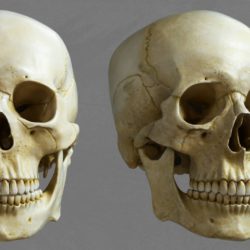
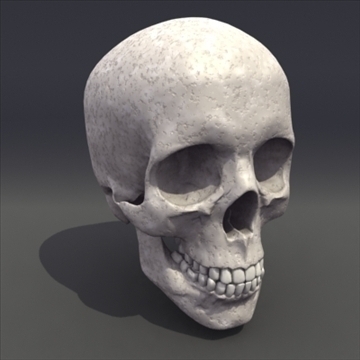
Skull 3d model on Flatpyramid.During the history of the skull formation, part of the bones of the skull goes through three stages - the membranous (in newborn babies, you can see remnants in the form of springs), the cartilage stage (like most skeletal bones) and the bone. These stages for humans and higher Mammals are temporary: moving from one to another, they correspond to permanent forms in phylogenesis.There is a definite correspondence between the development of the cranial skull and the brain. The development of the skull in humans is complex and is associated with the development of the brain and sensory organs. The cranial bones develop from sclerotomes of the head somites (derivatives of the dorsal mesoderm), the bones of the facial skull develop on the basis of visceral arches (derivatives of the ventral nonsegmented mesoderms). The first sign of human skull formation is an accumulation of mesenchyme (from head somites, that is, dorsal mesoderm) around the chord at the level of the hindbrain, from where the accumulation spreads under the front parts of the brain, forming the basis for the developing brain and sensory organs, and surrounds the brain bubbles from the sides ( The 5th week of intrauterine development - membranous skull, brain capsule). Soon the base turns into cartilage (mesenchyme cells turn into cartilage) and has nasal, eye and auditory capsules.The human skull of the 2-3rd month of intrauterine development has a cartilaginous base and membranous roof and is called the primary skull (cranium primordiale). In the primary skull, the merging of the primary parts is noticeable, which later become separate bones, but before the appearance of centers of ossification, the individual bones are not defined. With the appearance of centers of ossification (from the 8th week of intrauterine development), it is not immediately possible to determine the shape and boundaries of bones, since many bones of the skull are formed by the accretion of several bones and have several centers of ossification. The centers of ossification appear in certain places in the skull in a strict sequence, and the bone formations, gradually increasing in size, approach each other, replacing cartilage tissue. As a result, only layers of cartilage tissue are preserved at the base of the skull, and for the rest of their lives, there is cartilage in the anterior part of the olfactory capsule - the septum cartilage and the cartilages of the wings of the nose.The bones of the base of the skull, with which the capsules of the sense organs are connected, are phylogenetically more ancient, are formed on the basis of cartilage (ossify enchondralno) with the exception of the tympanic part of the temporal bone and the medial plate of the pterygoid processes of the sphenoid bone. In parallel with the ossification of the base of the skull, the development of the bones of the roof, which are phylogenetically younger and are formed on the basis of connective tissue (ossify endesmal), goes on. Initially, the areas of bone tissue are separated from each other by wide gaps of connective tissue. As bones grow, these gaps decrease, but by the time of birth they do not completely disappear.The bones of the facial skull (phylogenetically younger) develop on the basis of visceral arches and olfactory capsule, ossify endesmally (with a few exceptions). Thus, the cartilages of the visceral arches develop separately from the primary skull. The transformation of the visceral arches forms the skeleton of the facial skull.A part of the bones goes through the cartilaginous stage (hyoid bone, styloid process of the temporal bone), the remaining bones of the facial skull are formed as primary (integumentary) bones. The cartilages of the visceral arches undergo a reverse development, and the webbed bones develop from the adjacent connective tissue, where ossification centers appear.The lacrimal and nasal bones, the vomer, the ethmoid bone, the inferior nasal concha develop in connection with the olfactory capsule, the first three as primary bones, the last two as secondary.Download Skull 3d model on Flatpyramid now.